Go ahead and mix business with pleasure
Is the phrase “professional friendship” an oxymoron?
If you were asked to list your friends in one column and professional colleagues in another, would there be overlap, or do you keep these categories distinct—by design or by chance?
In a recent HBR piece, Paul Ingram, Kravis Professor of Business at Columbia Business School, describes asking executives to do just that, and after analyzing these lists of 1,500 executives, “found that those with more overlap tend to have bigger professional networks, higher career satisfaction, and higher incomes. Why? Because friendship is the domain of social exchange, which is effective for the exchange of information.”
Since the pandemic, as our society has struggled to land on what the new way of working looks like, several studies on friendship at work have popped up—probably because friends help us cope with hard times and also friends are potentially lost in more isolated working conditions.
Are friends the secret to getting ahead?
We know that there is a correlation between engagement and friendships, and now Ingram is saying there’s a correlation between income and friendships. And yet, having friends at work is also risky and something many of us have been warned against. Being professional and being friendly don’t mix!
The reasons for keeping distance are many. Maybe your definition of friendship doesn't fit workplace dynamics. Maybe you've been burned before. Maybe the professional persona you've built feels incompatible with your authentic self.
And if you are a woman, you are less likely than your male counterparts to mix business with pleasure. Julia Boorstin, who wrote a book on the subject, shares some findings in an article for Chief: “[Women] tend to be reluctant to mix business and pleasure; though women generally have more close friends than men do, research indicates that they are less likely to use their wider-ranging personal connections for professional advancement.”
And then there's conflict—which research shows is triggered when identity feels threatened. For leaders who lean on collaboration as a strength (especially common among women), facing conflict goes against our natural wiring. So we keep relationships at arm's length where the stakes stay manageable.
But as Amy Gallo, workplace conflict expert, reminds us, "Conflict at work can make…relationships work even better.” “Productive conflict helps us reach our goals,” she says in a recent episode of Gartner’s Talent Angle podcast.
“Also, know what you’re disagreeing about,” Gallo told participants at a 2025 National Institutes for Health Deputy Director for Management seminar, “It might be a personality or value difference. But is there something else simmering?”
When your Motivational Value System (MVS) is threatened, conflict is triggered. “A threat to self-worth is a definitive characteristic of conflict, and these threats can be real or perceived.” writes Tim Scudder in his guide to Working with SDI 2.0, a personality assessment that offers a portrait of one’s motives, strengths, and overdone strengths. Learning about conflict sequences shows us the way through the conflict by giving us frameworks for conversation.
Your MVS, i.e., your core identity, stays stable. What changes is how you deploy your strengths in different situations and relationships. Understanding your MVS, your conflict sequence, and your strengths portrait gives you a framework for navigating the mess.
Why do I trust this framework? The SDI isn't new; it traces back to ancient archetypes and builds on a scientific body of psychological study. The test-retest reliability proves your MVS stays stable over time.
Plus, I’ve seen it work again and again.
A co-founder recently came to me after discovering her partner had made a significant strategic decision without consulting her. "We've always made these calls together," she said. "Now I don't know if I can trust her.”
When we revisited her MVS we discovered the issue wasn't the decision itself. Her Blue MVS–altruistic and nurturing–meant collaborative input was core to her identity as a leader. The exclusion threatened her sense of worth in the partnership. Her co-founder's Red-Green MVS meant her underlying motives differed: she was driven to be judicious and competitive. She valued making the right call efficiently, even if it meant moving independently.
Once they understood each other's motivational systems, the conversation shifted from "Can we still work together?" to "How do we honor both our needs going forward?"
When your whole team understands these dynamics –everyone's MVS, conflict triggers, strengths and overdone strengths—you create relationships that can handle the messiness and deliver results.
You might even find the type of vulnerability usually reserved for friendships.
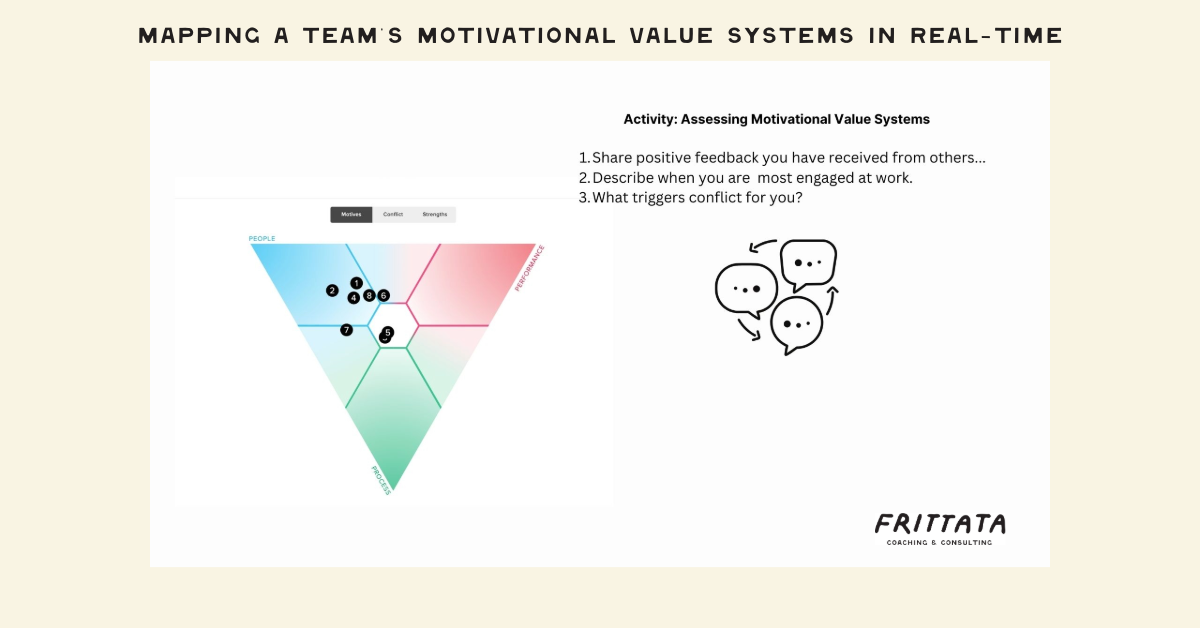
A team’s MVS map from a recent workshop
Curious about your own motivational value system and conflict sequence? Let's explore it in a discovery call.
What keeps YOU from mixing business and friendship?
Works Cited:
Ingram, P. (2026). "Don't Underestimate the Value of Professional Friendships." Harvard Business Review.
Boorstin, J. (2022). "How Networking Differences Play Into Workplace Gender Gaps at the Top." Chief.
Gallo, A. "Thriving on Conflict." Gartner Talent Angle podcast.
Scudder, T. Working with SDI 2.0. Core Strengths.