
Making Meaning at Work
If you work inside an organization, you have probably felt this neglect of its soul. You may think it impossible to tend to an organization’s soul, especially in a capitalist context. Prioritizing profit over the wellbeing of people is something we feel in the organizational culture, the way we and our colleagues behave day to day. It is too often reflected in an overly competitive way of being that leads to infighting and counterproductive competition inside the organization.
Tending to the Soul of an Organization
“Whoever loses contact with his or her own soul is in trouble. Similarly, organizations that pay no attention to matters of soul are in trouble, even when financially productive. The current practices of so-called downsizing, managed care and bottom-line thinking in business and academe have led to the effacement of soul and the erosion of morale.
Downsizing is a euphemism for depriving people of their livelihood. Managed care is really managed cost, a service only to insurance companies. Bottom-line thinking is too often thinking with your head in your bottom.”
–James Hollis, The Eden Project: In Search of the Magical Other
If you work inside an organization, you have probably felt this neglect of its soul. You may think it impossible to tend to an organization’s soul, especially in a capitalist context. Prioritizing profit over the wellbeing of people is something we feel in the organizational culture, the way we and our colleagues behave day to day. It is too often reflected in an overly competitive way of being that leads to infighting and counterproductive competition inside the organization.
Whether we are anointed leaders or so-called individual contributors, we often feel powerless to do anything about the soul-sucking nature of corporate culture. What’s happening underneath the surface on the individual level is usually a threat to our sense of self-worth. Our deepest most treasured values are being denied day after day. We think our ability to find meaning at work is limited or only possible if we are doing a certain type of “mission-driven” work.
Making Meaning
I’m here to tell you there are ways to make meaning that are not surface-level or cliche. I have worked in the managed care industry mentioned in Hollis’ statement above and been fed hard-to-believe platitudes about the people we were “helping” through our obviously self-serving business model.
I also managed to find personal growth through the relationships and meaning-making I cultivated consciously even in said soul-sucking environment. And I’ve spent lots of time and energy unpacking how that was possible so that I can help others do the same.
I have studied the works of Jungian practitioners like Hollis and certified as a Strength Deployment Inventory facilitator–a method with origins in related psychodynamic approaches. For the past three years I have also studied the discipline of Positive Leadership as an affiliated member of the University of Louisville’s Center for Positive Leadership.
I have seen how these methods can transform the leaders who practice them. By their nature, that is how they operate. Positive Leadership is “an episode in which one person exhibits the virtues that are relevant to that episode in exceptional ways that inspire others to follow.” Discrete, concrete. Powerful when repeated.
Relationship Intelligence is defined by Tim Scudder, author of Working with SDI, Third Edition: A manual for developing relationship intelligence, as “the ability to construct productive interpersonal relationships, and, when effective interactions cannot be maintained, to minimize the harm to integrity of self and others.” How might our organizations thrive if we all improved our relationship intelligence?
Being an exceptional, relationally-intelligent leader increases our sense of self-worth and lifts up those around us. It changes how we experience the world and how others experience us. Luckily, we know these are skills that can be taught. To those who want to learn.
How to Heal
“For corporate bodies to heal, they must have managers who will address the question of the soul,”
Hollis also writes in The Eden Project. My bet is that you are a leader who is willing to address the question of the soul.
If you are being called to make more meaning, lead others, and/or face impending change, perhaps a Frittata engagement is something you should consider. We help leaders tend to their own and their organizations’ souls through 1:1 coaching, leadership development programs, and team retreats. Our clients desire true transformation for themselves and their organizations. They are willing and eager to do the work.
Mission Statements Worth Stealing From
A mission statement does one job: it says what you do, every day, in service of something. Save the lofty stuff for your vision. Save the personality for your values.
A good rule: ten words or so. Although, there is a lot of flexibility here, and these days many companies are mixing vision and mission, going a little longer, and even treating mission statements more like manifestos. As long as there’s creativity, I’m happy.
Here are seven missions worth studying. Some are short. Some break the rules. These are all organizational, but personal mission statements are important, too. Read through these and formulate your own opinions. This poet shares a few of her thoughts, too.
Google "To organize the world's information and make it universally accessible and useful."
Eleven words. One sentence. A verb + noun that tells the what — organize + information; two adjectives that describe how—accessible, useful. Notice what's missing: search engine, ads, AI, products, technology. The mission describes the job, not the tools. That's why it has held up since 1998 even as everything Google does has changed shape. (Source: about.google/philosophy)
Patagonia "We're in business to save our home planet."
Seven words, and they updated the language from "cause no unnecessary harm" to this in 2018. The original told you what they wouldn't do; I think there’s way more power in saying what they are doing. And I love the ingenuity of “we’re in business” as the opener. Tell me you’re a B Corp without telling me you’re a B Corp. (Source: patagonia.com/ownership)
TED "Discover and spread ideas that spark conversation, deepen understanding, and drive meaningful change."
Twelve words. Three verbs doing three different jobs — discover, deepen, drive — escalating from curiosity to comprehension to action. This is what a good mission can do: walk you through a process, covering the why, how, and what. (Source: ted.com/about/our-organization)
Ellevest "Our mission is to get more money in the hands of women, their families, and the next generation through personalized, intentional wealth management and financial planning."
Twenty-six words, using a traditional framework with the “through” phrase. If it helps to share your services in your mission statement, that’s one way to do it. (Source: ellevest.com)
Rent the Runway "Our mission is to power women to feel their best every day and democratize access to fashion through our signature subscription programs, à la carte rental and resale offerings.”
Longer form. The verb "power" is the move — if I had a dollar for every time I saw the word “empower” in a mission statement, I could afford a RTR subscription. So I like how they still get power in there but without the cliché. This one feels more like a blended mission-vision to me, and it uses the “through” option to list services (the how). (Source: investors.renttherunway.com)
charity: water"charity: water is a nonprofit organization bringing clean and safe drinking water to people around the world."
Seventeen words describing what they do (bringing water), the kind of water (clean and safe), and who it serves (people around the world). For a nonprofit, it makes sense that there would be a little more than the what-we-do-every-day. Mission-driven orgs lean a lot on their missions! (Source: charitywater.org)
Frittata Consulting & Coaching"We blend strategy, intuition, and leadership development to fuel sustainable growth."
Twelve words. Three things blended (the how), one outcome (the what). I built this one with intention. I wanted to include a few things as differentiators: "sustainable"—not just any kind of growth—and "intuition" sitting next to "strategy" because that combination is also what makes Frittata special. Because the mission statement is only one part of the story, a word like “sustainable” can point to a vision statement, which often unpacks the why. (Source: me)
Go ahead and mix business with pleasure
Go ahead and mix business with pleasure.
Is the phrase “professional friendship” an oxymoron?
If you were asked to list your friends in one column and professional colleagues in another, would there be overlap, or do you keep these categories distinct—by design or by chance?
In a recent HBR piece, Paul Ingram, Kravis Professor of Business at Columbia Business School, describes asking executives to do just that, and after analyzing these lists of 1,500 executives, “found that those with more overlap tend to have bigger professional networks, higher career satisfaction, and higher incomes. Why? Because friendship is the domain of social exchange, which is effective for the exchange of information.”
Since the pandemic, as our society has struggled to land on what the new way of working looks like, several studies on friendship at work have popped up—probably because friends help us cope with hard times and also friends are potentially lost in more isolated working conditions.
Are friends the secret to getting ahead?
We know that there is a correlation between engagement and friendships, and now Ingram is saying there’s a correlation between income and friendships. And yet, having friends at work is also risky and something many of us have been warned against. Being professional and being friendly don’t mix!
The reasons for keeping distance are many. Maybe your definition of friendship doesn't fit workplace dynamics. Maybe you've been burned before. Maybe the professional persona you've built feels incompatible with your authentic self.
And if you are a woman, you are less likely than your male counterparts to mix business with pleasure. Julia Boorstin, who wrote a book on the subject, shares some findings in an article for Chief: “[Women] tend to be reluctant to mix business and pleasure; though women generally have more close friends than men do, research indicates that they are less likely to use their wider-ranging personal connections for professional advancement.”
And then there's conflict—which research shows is triggered when identity feels threatened. For leaders who lean on collaboration as a strength (especially common among women), facing conflict goes against our natural wiring. So we keep relationships at arm's length where the stakes stay manageable.
But as Amy Gallo, workplace conflict expert, reminds us, "Conflict at work can make…relationships work even better.” “Productive conflict helps us reach our goals,” she says in a recent episode of Gartner’s Talent Angle podcast.
“Also, know what you’re disagreeing about,” Gallo told participants at a 2025 National Institutes for Health Deputy Director for Management seminar, “It might be a personality or value difference. But is there something else simmering?”
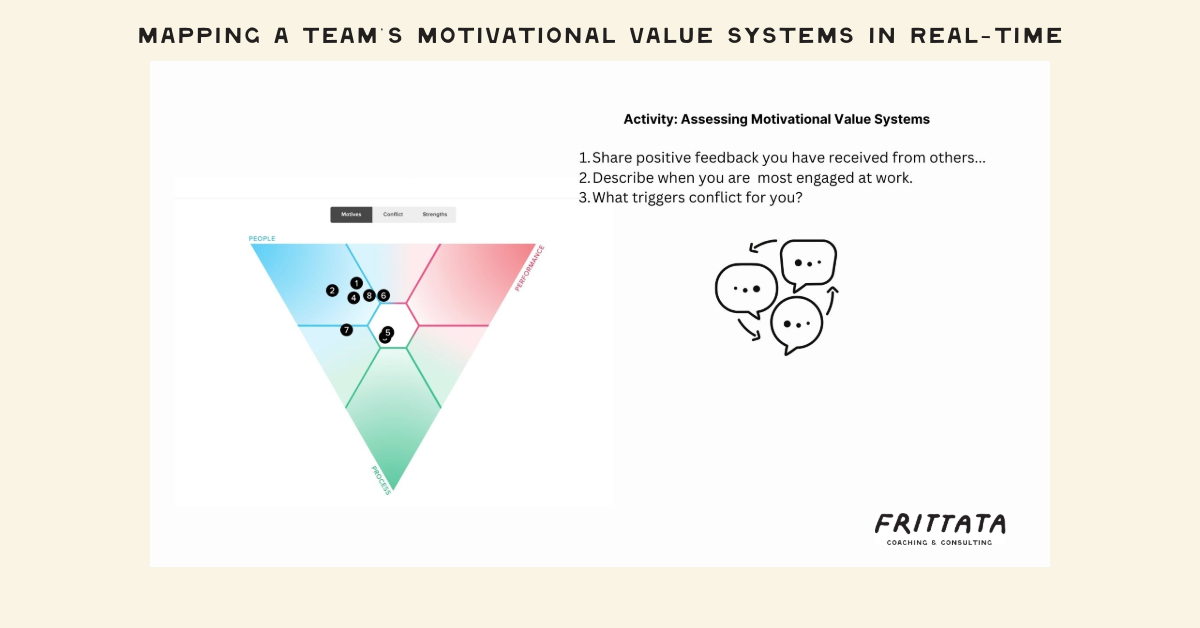
When your Motivational Value System (MVS) is threatened, conflict is triggered. “A threat to self-worth is a definitive characteristic of conflict, and these threats can be real or perceived.” writes Tim Scudder in his guide to Working with SDI 2.0, a personality assessment that offers a portrait of one’s motives, strengths, and overdone strengths. Learning about conflict sequences shows us the way through the conflict by giving us frameworks for conversation.
Your MVS, i.e., your core identity, stays stable. What changes is how you deploy your strengths in different situations and relationships. Understanding your MVS, your conflict sequence, and your strengths portrait gives you a framework for navigating the mess.
Why do I trust this framework? The SDI isn't new; it traces back to ancient archetypes and builds on a scientific body of psychological study. The test-retest reliability proves your MVS stays stable over time.
Plus, I’ve seen it work again and again.
A co-founder recently came to me after discovering her partner had made a significant strategic decision without consulting her. "We've always made these calls together," she said. "Now I don't know if I can trust her.”
When we revisited her MVS we discovered the issue wasn't the decision itself. Her Blue MVS–altruistic and nurturing–meant collaborative input was core to her identity as a leader. The exclusion threatened her sense of worth in the partnership. Her co-founder's Red-Green MVS meant her underlying motives differed: she was driven to be judicious and competitive. She valued making the right call efficiently, even if it meant moving independently.
Once they understood each other's motivational systems, the conversation shifted from "Can we still work together?" to "How do we honor both our needs going forward?"
When your whole team understands these dynamics –everyone's MVS, conflict triggers, strengths and overdone strengths—you create relationships that can handle the messiness and deliver results.
You might even find the type of vulnerability usually reserved for friendships.
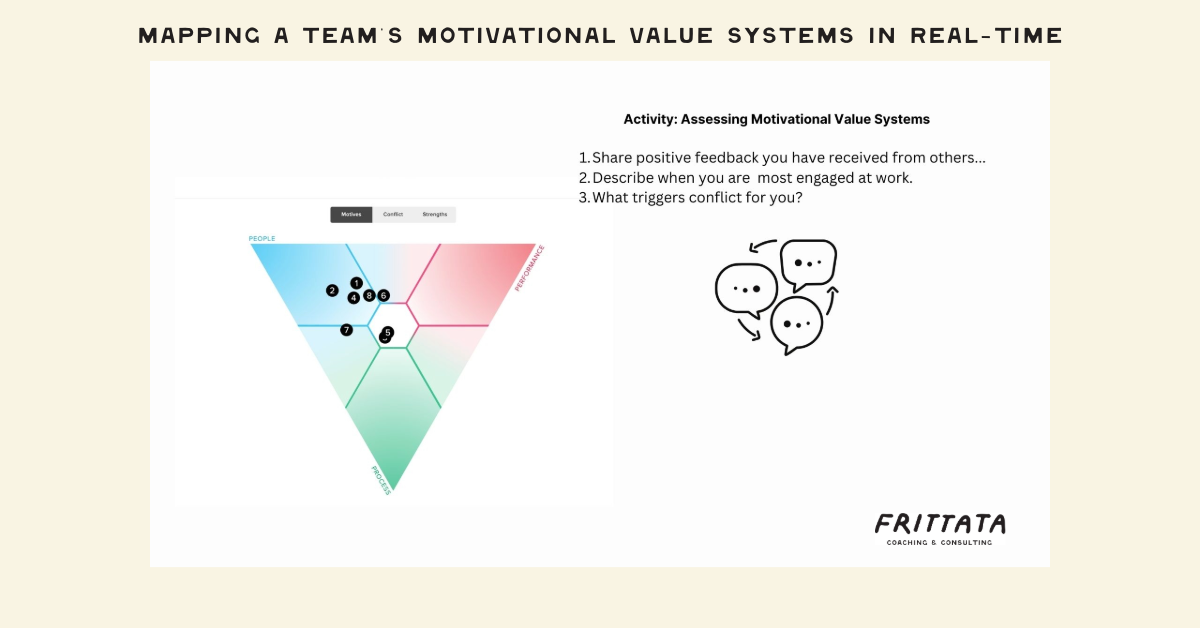
A team’s MVS map from a recent workshop
Curious about your own motivational value system and conflict sequence? Let's explore it in a discovery call.
What keeps YOU from mixing business and friendship?
Works Cited:
Ingram, P. (2026). "Don't Underestimate the Value of Professional Friendships." Harvard Business Review.
Boorstin, J. (2022). "How Networking Differences Play Into Workplace Gender Gaps at the Top." Chief.
Gallo, A. "Thriving on Conflict." Gartner Talent Angle podcast.
Scudder, T. Working with SDI 2.0. Core Strengths.